






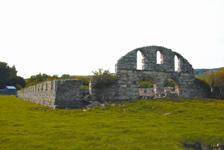
Courtesy of NZ Today magazine.
 It was the biggest woolshed in the Southern Hemisphere, but was destroyed by fire in 1924.
But what remains are the largest stone ruins in New Zealand. Brother, did I feel a chump when the cards, letters, phone calls and Emails rolled in telling me a “mystery” photograph I had published in the Central Otago feature in the last issue of NZT was the legendary Teviot woolshed. And to make matters worse, I placed in on the wrong side of the Clutha River! I was well aware of the previous existence of the Teviot Woolshed & the biggest woolshed in the Southern Hemisphere & but I had always thought of it as being closer to West Otago, than Central Otago. And I had also thought of it as being totally destroyed, not reduced to substantial ruins that are today Historic Place Trust protected.
I don’t know how many times I have driven the road from Millers Flat to Roxburgh via Teviot and not seen these ruins before!
When it became obvious what I had missed, I booked a flight to Dunedin and went to take a good look, including a quick, day-trip lap of Central Otago for good measure.
The Teviot Valley is seldom referred to by outsiders by its name & it’s simply the area that’s the gateway to Central Otago as you come down the other side of the hills after Beaumont and strike the flat area that’s generally called “Miller’s Flat” by outsiders.
But the Teviot Valley is a clearly defined area with several communities, the largest being Roxburgh. It’s also an area over which there has long been an air of uncertainty.
The Clutha River which flows from Lake Wanaka and the contributing Kawarau River that flows from Lake Wakatipu and joins the Clutha at Cromwell, is New Zealand’s biggest and most powerful river & not the longest, that is the Waikato. But where the Waikato has several hydro power stations, the mighty Clutha has only been tamed in two places, Roxburgh and Clyde. The potential is obvious, particularly given the number of places were damming the river would be comparatively straight forward.
 When the power gurus put together their master plan for the Clutha there were several options and several sites that were more than mere pencil marks on a wish list & the planners began actively buying up land and property for the day when they could start construction. Two of these sites are at Queensberry on the upper Clutha and at Beaumont on the lower Clutha. The latter would flood the gorge from Beaumont up to Island Block and then spill out over the flat area all the way to Miller’s Flat.
The protests over the Clyde dam were ignored by the National government, but many groups and individuals, including Miller’s Flat orchardist Rod Pierce appeared to stymie plans for the Beaumont dam and it dropped out of view.
That was possibly because when the Clyde dam was commissioned, it was excess to our electricity needs in the mid 1980s. But Electricorp had bought up pretty much all of the land and property it needed for the Beaumont dam, including houses and the Beaumont pub. And it retains ownership to this day, leasing the farmland to farmers and the homes and other buildings to people who have various uses for them. The Beaumont pub freehold is also likewise owned by what used to be Electricorp.
There’s a strong feeling in the Teviot Valley that this continuing uncertainty is holding back progress in the valley. Renting or leasing owners don’t put the same investment into their land or property that freehold owners do and many locals wish that Electricorp would make up its mind & either go ahead, have a brawl and build the Beaumont dam, or decide it’s too hard and sell the land and properties. End the limbo. There were no hydro dam schemes almost 155 years ago when John Cargill, son of Captain William Cargill, one of the founders of New Edinburgh, the Otago province, applied for the first major sheep run in Central Otago, which he would call Teviot after the area in the Scottish borders.
He was successful and leased what was estimated to be 64,000 acres of land, but this was seriously and deliberately underestimated to avoid having to carry as much stock as the lease would have demanded. In 1921, when many leases were trimmed back to provide small farms for the settlement of returned soldiers, a proper survey of the downsized Teviot Station still showed it to be 64,000 acres. It’s likely that John Cargill originally had close to 100,000 acres for his sheep!
The establishment of Teviot Station was the first move by Europeans to settle Central Otago. Over the next 20 years Cargill went into partnership with his son-in-law E. R. Anderson and developed and fully stocked this massive sheep station, importing high quality sheep, cattle horses, sporting dogs, turkeys and even rabbits from the UK.
They built a massive, sprawling homestead of 24 rooms outside of which was a small settlement of outbuildings, sheep and cattle yards, planted 25 acres of English trees and built the massive woolshed. At its height, Teviot Station employed over 200 people, either on the land, or in the great house and they had a small hydro electric power station supplying the homestead.
An event of some significance took place on Teviot Station. On a visit to the UK in 1876 Cargill met Alexander Graham Bell and was impressed with Bell’s invention, the telephone. Bell gave him two sets of phones and back on Teviot, Cargill installed one set at the homestead and the other in the Post Office at Roxburgh and had wires strung connecting them. The exact date is lost, but sometime in 1877, on the evening the wires were connected, the Postmaster’s daughter rang Cargill & the first phone call in NZ. However, like Richard Pearse, this first phone call was ignored and “officially” the first call was made a year later between two government departments & one in Dunedin and the other in Milton!
Much of this was a show of wealth.
 By the early 1880s the bubble had burst and prices fetched by lamb, wool and beef were down, resulting in a slump. Making matters worse, the rabbits they had imported for sport, were now threatening to take over the place. Cargill and Anderson starting recording losses, sold out and went overseas, taking their money with them.
This slump meant the end of the good times for many of the large, wealthy New Zealand land owners and the face of farming in NZ changed forever.
Ownership of Teviot Station then passed to W.T. Scrymgeour. He was a hard-headed businessman who managed to reverse the fortunes of the place. As part of his hard-headed approach to the business, he drew up a document detailing the terms under which shearers were employed. This became known as the Scrymgeour Agreement and became the basis for employment between farmers and shearers throughout Australia and New Zealand. It was a document that led to bitter strikes, particularly in Australia. By any standards the Teviot Woolshed was massive. The dates are uncertain but somewhere in the mid 1860s is thought to have been when it was built. And there’s also conjecture over its exact size. Most reports say it was 47.3 metres wide and 137 metres long. That it had forty shearing stands and could house up to 11,000 sheep. Those figures are now thought to have been exaggerated!
There’s a bit of mystery over where the roof came from. While the stone exterior walls were built from local materials & schist and sandstone, the roof either came from the Great Glasgow Exhibition or a temporary railway station in the UK. Either way, the roof was bought by Anderson and shipped to New Zealand. Even without the rural downturn, Teviot Station was simply too big to survive as one block and over the next 20 or 30 years it was downsized, carved up and sold off. What remained of the original was in government ownership by the early 1920s.
The Teviot Woolshed had become a bit of a cooperative, used by the farmers who had bought twelve of the farms that had been subdivided off after WW One.
According to local Teviot historian, John Crawford, social values had changed with the tougher times that were being faced in rural areas and petty crime was rife.
A detective from Dunedin was due to arrive in the area on the 12th of November 1924 to investigate allegations that some of the wool being stored in the shed was stolen.
He arrived to find the shed a smoking ruin, destroyed by fire on the night before!
Was this more than a coincidence? The most likely suspect had a watertight alibi & he was in Ranfurly, many kilometres away. While the shed was destroyed, the massive stone walls remained and over the years they became partly overgrown with climbing shrubs and matagouri and according to John Crawford were an eyesore and some parts of the sandstone walls were beginning to tilt, threatening to fall.
In 1982 the owner of the now small property on which the ruins remained, decided they had become too dangerous and bulldozed the end of the massive ruins that were at greatest risk. This is the end where the storage and loading out was done. About half of the ruins were demolished and pushed over a bank as fill. I had long been fascinated by the story of the Teviot Woolshed and was determined to go and have a look. Today, the property is owned by retired Dunedin lawyer Ian Douglas and his wife Caryl who have built a modern, architecturally designed, two storied home about where the original Teviot Station homestead had once stood & it fell into rack and ruin and was finally cleared.
 As I had discovered by accident the ruins and the west facing massive stone wall are clearly visible from the Miller’s Flat – Roxburgh Road and if you take Loop Road you come within metres of them.
I knocked at the door of the new house, met Ian Douglas and asked if I could take a look at the ruins. I was most welcome.
Even though only about half of the original length of the building remains, it is still enormous and they are the largest stone ruins in New Zealand.
Nothing remains of the original building within the walls & its now just pasture, bearing a good crop of mushrooms the day we visited.
Historian John Crawford has always doubted the claims of the size of the shed when it was complete. He has measured what remains & they are almost 26 metres wide (history says 47.3m) and almost 46 m long. It’s thought that about 52 metres in length were removed in 1982, making the complete overall length about 100 metres (history says 137m).
Most farmers say that the claims of 11,000 sheep inside would have been greatly exaggerated. It was more likely 5,000.
Despite the down-sizing from the original figures, there’s no doubt that the Teviot Station Woolshed was a huge building and a massive show of wealth from a golden era of wealthy landowners in New Zealand. At their height, these run owners contributed about 70% of the NZ wool clip, but owned just 6% of the total number of sheep farms.
John Crawford has written a fascinating book & “Tales from the Woolshed” about the early settlement of the area to mark the 150th anniversary of the European settlement of the Teviot Valley and surrounding areas. It’s a story of massive early NZ sheep runs which generated enormous wealth for the owners of which few remain. One however does and that’s Beaumont Station, a neighbour of Teviot Station and still one of the half dozen biggest “farms” in New Zealand today.
 And while the Teviot Station Woolshed may have been the grandfather of them all, there are still some whoppers existing in New Zealand. Nearby Moa Flat Downs has a monster surviving from those early years and I think I may have mixed the locations of Teviot and Moa Flat in my ignorance of the Teviot ruins. There are also very, very large woolsheds in the Lindis Valley and also at Anaura Bay on the East Coast.


cloncurryclive - 18 years ago
Good on you allan. Love your stories and millars flat area cloncurry clive