






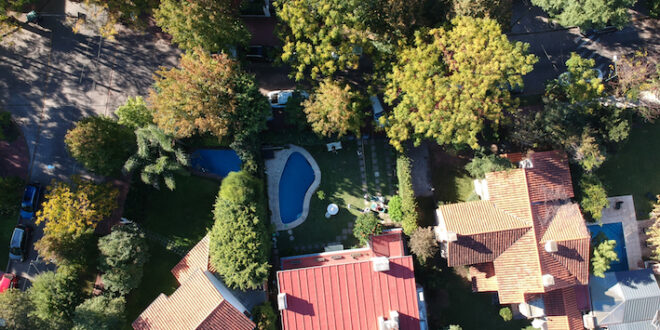
Neighbours! Often modern life is so busy you hardly ever see them. Occasionally they become good friends. Sometimes they turn out to be monsters that can ruin your enjoyment of life and plunge you in to your own suburban soap opera of arguments and recriminations.
Unfortunately disputes between neighbours can take a long time to resolve. Because of the close proximity of the problem, it always seems to be staring you in the face or assailing your eardrums. Trees, dogs and noise are three of the most common sources of neighbourhood friction. What can you do about them? The recommended first step is always to try and talk calmly to the neighbour about the problem and see if an amicable solution can be found. Persons anxious or afraid about approaching an aggressive neighbour may find it useful to involve the local community police constable. If this direct approach fails, you need to look at your legal rights and remedies.
If trees are growing close to a boundary and causing a problem there are several steps you can take. You are entitled to cut back overhanging trees to the boundary line. Legally the cuttings belong to the tree owner and should be put neatly back on the neighbour’s side of the fence. The same principle applies to fruit bearing trees. The common belief you are entitled to pick the fruit hanging over your boundary line, or eat the fruit that falls on your property, is legally incorrect. However, the encroachment of the neighbour’s tree is also technically a trespass on your property. Hopefully commonsense will prevail and the neighbour will not charge you with theft for eating a windfall apple and you will not sue him in trespass for the encroachment. Your average judge would not be impressed with such actions.
If the neighbour’s trees are blocking your view, likely to cause injury or damage, or reduce the enjoyment of the residential use of your property, it is possible to apply to the District Court for an order they be removed or other remedial action be taken. Under The Property Law Act 2007, the Court is required to weigh up the hardship to the respective parties that might be caused by the removal or non-removal of the trees. Such a court action can be expensive and is not as simple as it sounds. It may seem obvious to you the neighbour’s trees are causing a nuisance, but you will still have to prove this by evidence acceptable to the Court. Expert evidence from an arborist or a landscape architect may be required to prove your case. Photographs taken at different times of the year showing the effects of light and shade can also be useful.
Dogs barking for hours on end can be a major source of nuisance to neighbours. The Dog Control Act 1996 deals with this problem. If the dog is causing distress or nuisance to neighbours, a dog control officer or ranger upon receiving a complaint can enter a property to investigate and, if appropriate, serve a notice on the owner to abate the nuisance. Failure to comply with a notice can lead to the dog being removed and/or the owner being prosecuted. Council bylaws usually contain provisions relating to the control of dogs, including regulating the number of dogs allowed on a property. The bylaws often deal with other animals, such as cats and roosters. A phone call to your local animal control officer is usually the best first step for dealing with animal problems. If the concern is about the welfare of animals, then the SPCA should be contacted.
Under The Resource Management Act 1991, noise is regarded as an ‘environmental issue’. Local authorities are required in their District Schemes to protect people from excessive and harmful noise. The noise permitted in the inner city or a commercial area will be different to a suburban street. Different rules will apply for construction work or special events. For most residential areas the simple test of reasonableness is assessed by a Council Noise Control Officer taking into account, the time of day, other noise in the area and the likely effect on a complainant. Persistent offenders can have equipment seized and be prosecuted. Not all noise is the responsibility of the Council. For example, noise caused by motor vehicles, planes flying overhead and trains or harmful noise inside a work place, is the responsibility of other agencies.
Many activities that sometimes annoy you may not have a ready solution. Your neighbours have a right to grow trees, own a dog and to make some noise in the course of the everyday enjoyment of their property. It is usually a case of assessing reasonableness and balancing competing interests.
Disclaimer: The information contained in this article may not be up to date and is of a general and summarised nature only. It should not be used as a substitute for obtaining personal legal advice.
© Terry Carson 2009

Join the Discussion
Type out your comment here:
You must be logged in to post a comment.