






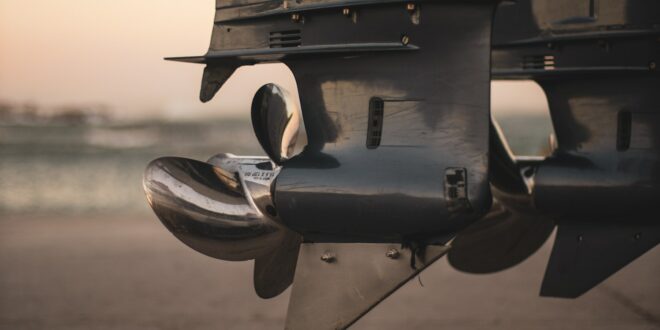
Repowering your vessel usually comes about because the existing engine needs a major overhaul or replacement. Or maybe you want increased performance. Whatever the reason, warns John Menzies, proceed cautiously.
Replacing an exhausted engine is relatively straightforward if the replacement produces similar horsepower at the same revolutions. Provided it fits into the same footprint as the old engine, the only modifications required might be to the exhaust system. Repowering projects, however, are very rarely as simple as this…
Let’s assume you’re replacing your old six cylinder, naturally-aspirated Ford that turned out 100 HP at 2450 rpm, driving the 19-inch diameter prop through a 2:1 ratio gearbox.
In the market today there is a wide selection of engines producing between 90 and 110 HP that could replace your 100 HP Ford. They include Iveco/Fiat, Lugger, Nanni, Perkins, Volvo and Yanmar. But none of these engines will be rated at the same rpm of 2450 as the Ford.
To effectively turn your old prop at 1225 rpm (as the Ford did) you’ll require a different gearbox with a higher ratio. As an example, the Yanmar 4JH3-THE produces 100 HP at 3800 rpm. This is a four cylinder, turbo-charged, inter-cooled diesel weighing 258 kg, including the gearbox.
The old Ford weighs around 680 kg including gearbox – 422 kg heavier. If you were to use your old prop, the gearbox ratio on the Yanmar would be around a 3:1 ratio to get a shaft speed of around 1266 rpm. As the vessel would be nearly half a tonne lighter, its performance for the same engine horsepower should improve slightly.
For those of you mathematically inclined, a planing hull vessel normally behaves according to the following formula:
Speed = K Factor multiplied by the square root of the total Shaft Horsepower divided by the vessel displacement (in long tons).
The “K” coefficient is dependent upon hull form and the vessel’s speed/length ratio. From actual experience “K” has been determined as follows:
Values of “K”
Loaded water line in feet semi-displacement (round bilges, flat at transom) planing (vee bottom, hard chime) 20 2.25 2.75 25 2.40 2.90 30 2.60 3.15 35 2.80 3.40 40 3.05 3.65 45 3.24 3.85 50 3.34 4.00
Let’s now assume you’re repowering because you want better performance than your existing engine offers. An example would be a Mark 1 Corsair with a 210 BHP Caterpillar 3208 or 210 BHP Detroit 6V53 installed. These reliable workhorses gave the 7 – 8 ton 36-footers a maximum speed of around 16 knots and a cruising speed of 13 to 14 knots when fully loaded.
Using a 2:1 ratio gearbox, the propeller size would be around 24 inches by 20 inches of pitch (three blade), or 20 inches by 16 inches if a 1.5:1 gearbox was installed. At the time these launches were built the light-weight, turbo-charged and inter-cooled diesels of today didn’t exist. The biggest diesels installed were the 275 BHP Detroit 6-71M that gave a top speed of around 18 knots – not a fast speed by today’s standards.
You are now looking at repowering to achieve a cruise speed of say 19 knots and a top speed of 22 knots. Where will we start in this exercise?
It is not simply bolting on a higher HP engine to the existing shaft and prop. Based on the “speed” formula, the existing vessel has a “K” factor calculated as follows:
Speed = 16 knots (known as tested over the measured mile)
SHP = 210 x 0.97 (i.e. 204 shp)
Weight = 8 tons
Therefore “K” = 3.168
Assuming a similar weight all up of 8 tons and a maximum speed of 22 knots, the required shaft horsepower required would be 386 or 398 BHP, i.e. an engine producing around 400 BHP or 405 MHP.
The most important thing is to see if you can harness this extra horsepower correctly. Can you efficiently swing a large enough diameter propeller in the existing aperture and still have sufficient tip clearance? If the propeller is too small in diameter, the extra horsepower will only create very expensive froth, and no real increase in speed.
It is probable a larger diameter propeller shaft will be needed and the strut moved further aft to allow for a larger diameter propeller. And for the extra horsepower, larger air intakes and larger diameter exhaust piping and mufflers will be required. The fuel line piping and primary fuel filter will also require upgrading to handle the near doubling of horsepower.
Case Studies
 A few years ago my father replaced the old 180 HP Ford in his 36-foot Vindex with a higher horsepower model (250 HP) of the same engine. The old engine gave a 15 knot maximum speed, and the new engine should have given around 18 knots. To make the old propeller spin faster, the gearbox ratio was changed from 2:1 to 1.5:1. Exhaust system was left unchanged.
The first sea trials were a great disappointment! Top speed remained the same (15 knots) and engine rpm was down by 400. What had we done wrong?
Out with all the test gauges, including exhaust back pressure. Another set of sea trials and at full throttle the exhaust back pressure was twice that recommended by the engine manufacturer.
The old exhaust system was choking the engine. A larger diameter exhaust and water lock muffler was installed (more dollars). Further sea trials with test gauges attached found the exhaust back pressure to be within the required limits and the engine rpm raced up to the required 2450. Speed over the measured mile came in at full throttle at 18 knots with a 15 knot cruise at 2150 rpm. Spot on. The repower exercise was successful, achieving what the speed formula predicted.
A couple of years ago a client contacted me to undertake a repowering assignment. One of the original 800 HP V8 engines had failed and required a full rebuild. As only 20 of these engines existed world wide (these were the only two in New Zealand), rebuilding was considered uneconomic: it was cheaper to install new engines and retain the original gearboxes and drive train.
The owner had five possible engine options – ranging from 715 HP to 833 HP. Taking into account the difference in weights, horsepower, speeds and fuel burn at maximum and cruise output, a detailed comparison was undertaken. All the engines (bar one) would require a new set of propellers to be built.
After considering the different performances, costs and delivery times (along with the engineering required) a pair of Caterpillar C12’s was selected. The lower horsepower of these engines along with a weight reduction of 0.9 tons gave a projected top speed of 29.8 knots and a cruise speed of 26 knots.
The moment of truth – sea trials.
With full fuel and water on board, we went over the measured mile (twice, to get an average speed) at wide open throttle. It came in at just over 21 knots, well short of the 29.8 predicted and 11 knots slower than the original engines! Horrors, large buckets of dollars spent and a dismal result.
More tests. First, we put fuel consumption testing equipment on the engines. Yes, they produced full power and rpm and were burning the fuel Mr Caterpillar said they were entitled to burn.
We then measured the propeller slip. It turned out to be over 40% – well above the 20 to 22% we expected. If the slip factor of these new propellers was around 20 to 22%, we would have had our 29 to 30 knots.
The next step was to reinstall the old propellers and see what happened. Up to over 31 knots but not pulling the required 2330 rpm – so the engines were in overload. Now we knew what the problem was. The new propellers were not working properly and were making froth rather than forward propulsion. Back to the owners, who decided to have a new set of propellers manufactured.
The lesson? To save costs the owners had decided to install a cheaper set of propellers. This proved to be an expensive mistake as it is the propeller that gets the horsepower into the water, not the engine. Six weeks later, with the new propellers fitted, 29 to 30 knots appeared on the GPS.
Repowering is an expensive exercise and must be approached from the ‘propeller back to the engine’ – not the other way round. Don’t cut corners, as it doesn’t take much to make the exercise an expensive and futile waste of time with little or no increase in performance gained. Take advice and don’t hesitate to contact designers or marine engineers/consultants who have a proven track record in this field.

- 11 years ago
A great understandable article – and a good reminder to us all that knowledge and experience are so important in the real world – thanks John for sharing your knowledge.