






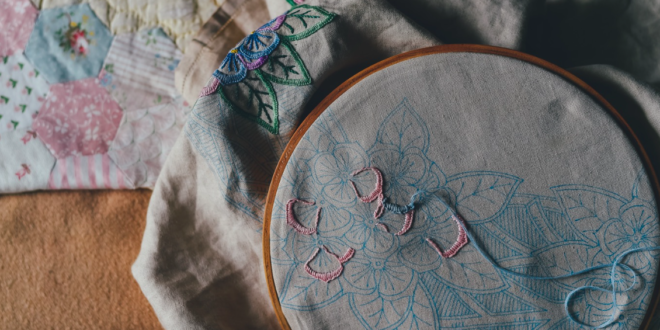
One of the most confusing aspects of needlepoint is defining the different terms used in needlework. The term “needlework” is the broadest term used to describe any form of creative endeavour that is worked using a needle. Among the many varieties of needlework exists the term “needlepoint”, but we will get to that in a moment… Embroidery, quilting, rug making, knitting and crocheting are also covered under the enormous umbrella of the term “needlework”. In this article; we will be discussing needlepoint, embroidery, and tapestry.
First of all, let us get tapestry out of the way. The term “tapestry” is often misused in connection with needlepoint and embroidery. This is not a form of needlework. It is, however, a form of “textile art”. Tapestry is a woven fabric, created by hand or machine. The design is created through an intricate weaving process. Needlepoint and embroidery works are often confused with tapestry work because the finished products closely resemble each other. In the simplest terms, needlepoint and embroidery are worked ON the canvas or fabric, whereas tapestry IS the fabric.
 Now let us move on to embroidery. Embroidery is the art of embellishing or decorating textile fabric. Almost any fabric may be embroidered. The two most common materials for embroidery are cotton or linen. Throughout the centuries, clothing, furniture and a large assortment of other day to day items have been embroidered. Almost any type of thread may be used for embroidery, floss being the most common. Believe it or not – in the past human hair was used to embroider. Personally, I prefer to keep my hair attached to my head and use floss for my embroidery projects. Often, objects may be embroidered into a piece. Decorative stones, beads or shells can be worked into a fabric using embroidery. Until the 19th century embroidery was referred to as “canvas work”. During the 16th, 17th and 18th centuries the term “petit point” was commonly used to describe embroidery. Today, petit point refers to needlepoint that is worked on canvas that is 16-mesh or smaller. There are two different methods of classifying embroidery. The first method divides embroidery into two groups: surface embroidery and, as previously mentioned, canvas work. Surface embroidery encompasses any design that is worked on top of the fabric. Canvas work consists of any design that is stitched into the canvas. These two terms are very broad and not very enlightening. I prefer the second method of classifying embroidery. The second method divides embroidery into two groups that are easier to understand: counted thread embroidery and free embroidery. Counted thread embroidery consists of any piece that is worked using a pre-determined pattern. The pattern may be printed on the fabric or not. Counted cross stitch and needlepoint are the two common types of counted thread embroidery. Yes, I said needlepoint is a form of embroidery. I will get to that in a moment… Free embroidery is a form of embroidery that does not worry about the foundation fabric. A free embroidery piece is worked without counting or design. Each stitch is placed independently, hence the name. Crewel work is an excellent example of free embroidery.
Finally, we come to needlepoint. What is needlepoint? Needlepoint, as I stated earlier is a form of embroidery. Remember, embroidery was commonly referred to as “canvas work” before the 19th century. Today, canvas work is called needlepoint. While embroidery is worked on either cloth or canvas, needlepoint is worked primarily on canvas. Woollen yarns are used for stitching needlepoint projects. Needlepoint stitches are “patterned” stitches. That is to say, stitches that have pre-determined counted patterns. There are literally hundreds of needlepoint stitches. Many of these stitches started out as embroidery stitches and have been adjusted for needlepoint canvas. Some of the more common needlepoint stitches are: cross stitch, bargello, gobelin stitch, basketweave, tent stitch, continental stitch, back stitch, chain stitch, and diagonal stitch. These are just a few of the many needlepoint stitches available today. For a more comprehensive list of these stitches, with instructions and diagrams, visit Stitchopedia … an encyclopaedia of needlepoint stitches.
These are the definitions of tapestry, embroidery and needlepoint in the most simple of terms. Basically, tapestry is the art of weaving the design into a fabric, thus becoming the fabric itself. Embroidery is the art of embellishing and decorating an existing fabric. Needlepoint is the art of working the design into canvas. Whichever type of needlework you choose to engage in, all have the capacity to give many hours of creative pleasure to you.
Article by Carolyn McNeil.

Joybel - 9 years ago
Great articles on ways to improve our artistic leanings using inexpensive means and methods. one can make changes at little cost using some imagination or just “borrowing” an idea from these GrownUps ideas. The embroidery story is brilliant, and I just may give my needleworked pictures another hanging on the walls this year. I was always fascinated with the Bayeaux Tapestry story. Such an epic production.