






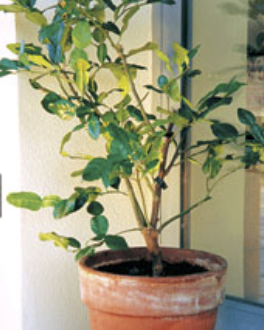
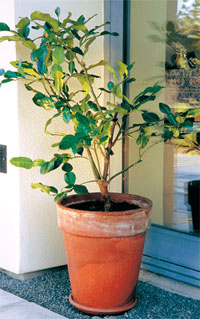
 Kaffir lime leaves are an essential ingredient in Thai food, and easy to grow – with a little protection from the cold.
Having an orangerie always seems like a romantic idea, and in southern climes it may be the only realistic option for people to grow citrus – other than the hardy Meyer lemon which will do well in some local microclimes or even tucked under the eaves on the north side of the house. Kaffir limes are definitely in the tender category, they require a minimum temperature of 12 – 15C all year round.
If you don’t have plans or dollars for an orangerie then a kaffir lime will survive quite nicely inside, in a pot in a north-facing window. Mine have resided in the same pots for four years now. Rather than potting them on into bigger pots which are hard to move I have removed them from the pot every second year and trimmed a third off the root ball and repotted them into the same pot – a pseudo bonsai procedure, which they don’t seem to mind.
I do have to confess that all of the leaves have fallen off on more than one occasion, but it is usually because they have been under-watered in the summer, over-watered in the winter, accidentally left outside or some such human error. Over the summer they get to sunbathe as much as possible and even spend a week or two in the tunnel house, although out there they are more likely to lose their leaves than if they remain in the house beside a just-open window.
The kaffir lime – Citrus hystrix – is common in Asia from the Philippines to Sri Lanka. It is best known as an essential ingredient in Thai cuisine. The leaves are known as bai makrut in Thailand and you may see the tree referred to as a Makrut lime. Kaffir limes are relatively small trees in their natural habitat growing only 3m to 4m in height.
They have bright evergreen leaves with a characteristic bilobed appearance and a wonderful aroma when crushed. They have the typical tiny white flowers seen on most citrus with an accompanying citrus fragrance. In tropical areas kaffir lime trees are an intrinsic part of the landscape as well as the cuisine. The Thais believe that the bai makrut wards off evil spirits, and kaffir lime trees are commonly planted at property entrances for this purpose.
Evil spirits
In many parts of Asia kaffir lime is also used for medicinal purposes. The juice is particularly well regarded as a hair rinse. It is said to ward off the evil spirit dandruff and a cut kaffir lime fruit rubbed on the skin will also apparently remove unwanted leeches! The juice can be used for cleaning and removing stains and it has insect repellent effects. All these properties are related to the citronellol compounds it contains which are common to all citrus.
The trees readily form small knobbly limes, even in a pot. These can be squeezed to produce a drop of juice and sliced thinly to garnish a cold summer drink or zested, but the prime culinary attraction is the leaves. Dried leaves have no real culinary value, and frozen leaves are only marginally better. Trees have been readily available for some years now so a potted kaffir lime is the best solution for the keen cook.
Kaffir lime juice should not be used as a substitute for common lime juice as it is very pungent but the reverse substitution will give acceptable results. The juice should only be used sparingly in dressings and sauces as it can easily overpower other flavours. The zest is used in curry pastes but the white pith needs to be assiduously avoided, as it is extremely bitter.
The essential tools for using kaffir lime leaves are a sharp knife – so that they can be finely shredded and easily digested – and a pair of tongs. In some dishes torn or crushed leaves may be called for – these need to be removed before serving, as one would remove a bay leaf from a western dish.
Traditional tom yam gung, the hot sour salt soup found in many Thai restaurants uses kaffir lime leaves torn to release their aroma along with chopped pieces of lemongrass. The heat is created by chillies; the saltiness by fish sauce (man pia) and lime juice balances that with a sour note. Prawns are the commonest addition to the soup but mussels, pipi or chunks of fish can also be used. Versions of tom yam gung are endless but the best always use fresh ingredients and a stock base made with the heads and shells of prawns or fresh fish off cuts.
To finish a spicy meal or to refresh the palate on a hot humid day you could make sugar syrup infused with lemongrass and kaffir lime leaves and then use it to marinate a tropical fruit salad – pineapple, melon, mango and any other fresh fruit mix.
So even if you live in a frost prone area you can have a touch of tropical lifestyle with a potted kaffir lime.
One you’ve grown your trees, give this kaffir lime and coconut fish curry recipe a go.
Words by Dianne Leighton. Photos by Juliet Nicholas.

- 19 years ago
Hello,
I am seriously thinking of planting a Kaffir Lime in my garden, but I am worried about the cold weather during winter, you see I live in Auckland! Would it still be possible to plant one under this circumstances?
Thanks,
Pacifico