





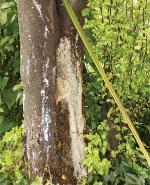
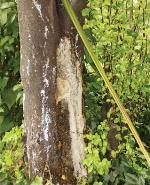
 Q: Our lovely large, old pittosporum has splits in the bark on its trunk and lots of white foam oozing out which has a strong smell. The tree actually looks quite healthy though it had some branches pruned off about a year ago. I scraped off some of the gunge and found small wormy things wriggling around in it and what could be borer holes in the trunk. It’s a lovely tree and at this point we’d do anything to try to save it. Is this problem likely to spread to other trees?
A: I’ve talked to a few contacts and we’ve come to the conclusion your pittosporum is suffering from a fungal or bacterial attack (possibly both) which has infected the tissue beneath the bark. The diseases could have entered the tree through old pruning wounds or the borer holes. Lemon tree borer is a native insect which lays its eggs in a wide range of trees and shrubs and larvae damage opens up the tree to secondary infections. Being a relatively old tree badly infected in the main trunk, as your photos show, it is unlikely it will survive for much longer. You may get new growth for some time but the damage to the tissues in the trunk will probably spread and, I’m sorry to say, the tree will almost certainly succumb.
The smelly foam is fermenting pittosporum sap oozing out of the wound and the “wormy things” are probably maggots from eggs laid in the brew by opportunistic flies. Unfortunately, there’s nothing I can suggest to help, as the damage is in the vital tissues of the trunk.
The best thing is to cut the tree down and plant another in its place. Diseases like this are widespread, their spores are everywhere, but they seldom affect vigorously growing, young, healthy trees and shouldn’t spread to others unless they also become weakened or damaged in some way.
IS TREATED TIMBER SAFE?
Q: Is it safe to grow vegetables in a raised garden built out of treated timber? Have any tests been done to show if anything leaches into the soil?
A: There is often quite a lot of debate around this subject. The timber treatment process impregnates timber with copper, chromium and arsenic and the end product is often called CCA treated or tanalised timber. Last year, Dr Mick Hedley, senior scientist in wood processing at Ensis in Rotorua (the former Forest Research Institute) provided some useful information on the possible adverse effects of using CCA-treated timber around the garden.
On reading it I’ve come to the conclusion that it is generally accepted by authorities (including the NZ Environmental Risk Management Authority and the US Environmental Protection Agency) that, to the average member of the public, exposure to arsenic from CCA treated timber is unlikely to exceed World Health Organisation guidelines. Leaching into soil from CCA-treated timber garden edges is said to be minimal as the chemicals are ‘fixed’ within the wood. But if you are particularly concerned it is suggested you plant no closer than 35cm to the timber edge or place a plastic or polythene barrier between vegetable garden soil and the CCA-treated timber edging.
You could of course use untreated timber, though in many cases this is a more expensive option and in contact with the ground it will rot, sooner or later.


KatyBuck - 18 years ago
How can I be sure of wholesome, bug free Fejoas next season?
That is the Fejoa bug that seems to be rife in Northland.
Cheers
KatyBuck