





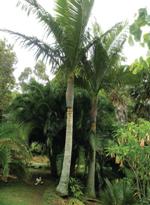

OUR fascination with palms is rooted in their association with the tropics and memories of idyllic holidays abroad. Recreating that scenery in our own backyard is a compelling but surprisingly achievable task. Three or so decades ago the giant Phoenix canariensis and the scruffy-looking Trachycarpus (windmill) palms were about all there was to be seen in New Zealand. These days there seem to be palms everywhere – some of them hopelessly inappropriate for their setting. In northern gardens we can grow a surprising number of exotic palms and although some young specimens struggle in our sodden winters, some Auckland collectors have over 130 different species in their gardens. Queen palms and Mexican washingtonias are the most commonly grown species in the North Island. Big, hardy and fast growing, they are often too big for urban gardens and deserve greater space so their imposing size doesn’t overpower the setting. For instance, it is alarming to see young specimens of both species planted centimetres from walls when their bases can reach almost a metre in diameter within a short time while after 20 years they can be 20m in height. There are many more suitable candidates for small gardens that will never outgrow their welcome.
Here are seven of my favourites:
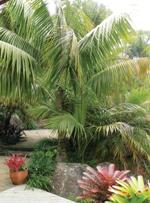 1. Howea fosteriana, the kentia palm, from Lord Howe Island. A relative of our nikau and almost equally hardy, this slim, graceful beauty thrives in shade or sun as long as the soil is friable with steady moisture through the year. It is surprisingly resilient to wind and light frost, growing steadily to about 5m after 10 to 15 years. Its arching elegant fronds form a handsome umbrella over a courtyard, pool or patio. More than any other palm the kentia gives a NZ garden the tropical ambience that coconut palms provide in the tropics. Every few years I plant a young one at the feet of my older kentias so they can grow up together as a multilevel family group, the different sizes leaning elegantly apart. Palms seem to sit more comfortably when clumped in a landscape. I like to plant kentias among big mossy rocks, not because it’s necessary, but because the boulders seem to accentuate their graceful, aerial structure.
2. Hedescepe canterburyana is another class ic from Lord Howe Island. It is instantly recognisable as a nikau relative. Its arching, glossy fronds emerge from a plump silvery-white crown-shaft and the curving trunk remains green and shiny throughout its long life. It is remarkably wind-hardy and adaptable to our climate, tolerating light frost and preferring dappled light when young but becoming sun-hardy as the trunk develops after a few years. This palm is slow growing, like the nikau, but one of the most graceful and elegant of all.
3. Archontophoenix purpurea, one of the rarest of the nikau family comes from North Queensland. Better known as the Mt Lewis palm, it is found in a few groves on the highest reaches of Mt Lewis and its neighbouring peaks. It is more wind-hardy and cold tolerant than its closest Australian relatives, the Alexandra and bangalow palms. Its unusually large, leathery fronds have silver undersides, while the crown-shaft is a striking reddish- purple. From a distance it resembles a large nikau, though the leaves arch more. The similarities between these southwest Pacific palms bear witness to their common Gondwanaland ancestry. This palm should grow well in frost-free areas as far south as the East Cape (good wind shelter helps)
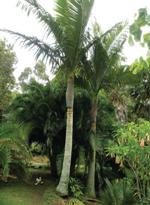 4. Dypsis baronii, which comes from the other side of the planet, is another favourite. This lovely, multi-trunked and clumping sugar cane palm from Madagascar has delic ately arching fronds and striking yellow stems. It is easily mistaken for its close relative, the familiar golden cane palm commonly seen in Australia’s subtropical cities, but Dypsis baronii, the sugar cane palm, is much harder in NZ’s cooler clim ate. It grows to about 4m high with up to a dozen slender stems supporting a layered canopy of narrow, pale green leaflets. A perfect poolside palm in a small garden, it needs moderate shelter and bright, dappled light, but adapts to full sun within a couple of years. It thrives in Auckland, as far south as coastal Bay of Plenty and warm frost-free spots elsewhere.
5. Chamaedorea cataractarum, the cataract palm, grows naturally in Mexico along streams and waterfalls where it is often waterlogged and misted with spray. It is a dainty little multi-stemmed clumper with dark green, curling leaves and thrives in dappled light and wet (or well-drained) soil. It grows slowly, eventually reaching about 1.5m with stems only 3cm thick. Perfect for a damp bush path or shaded courtyard, this species is tough and resilient in our soggy, cooler climate and handles dappled shade but is damaged by frost – though should be all right in a bush setting under the canopy. It has the appearance of a lush shrub rather than the usual leggy palm look.
6. Butia capitata, the Mexican jelly palm, is bulletproof in coastal conditions where palms become shabby and battered by salt winds. It is a stout, chunky species with strongly arching, blue-grey fronds curling almost to ground level. Even after 20 years it will seldom exceed 4m in height. The fat, orange berries smell and taste like jelly crystals. It looks most dramatic growing away from other trees or perhaps among boulders or dunes where its striking form and colour is displayed to full effect. This one is hardy down to minus 3-4 degrees C so will thrive in many parts of the North Island and warmer parts of coastal South Island.
7. Phoenix roebelinii, the popular pygmy date palm from the mountains of Laos, thrives here and seldom outgrows its welcome in a small garden. Eventually, it may reach 3m or more but the trunk is slender (10cm to 12cm in diameter), often curved and knobbly and the 70cm fronds form a lush rounded head that stands up to wind and light frost with ease (but not heavier ones). It will even grow in warm spots of coastal South Island. It is perfect for a small courtyard among boulders or underplanted with bromeliads.


Join the Discussion
Type out your comment here:
You must be logged in to post a comment.