






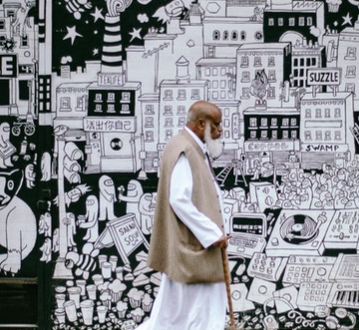
In the developed world we are at a stage where it will be possible, for the first time in history, to have a greater balance of wisdom. Partly this is due to the rapidly ageing population and partly to the accessibility of information, experience and ideas from the World Wide Web.
The possibilities are incredible but if we are not prepared to take personal responsibility the future could be grim. This is the choice we all face. Personally, I want to campaign for a wiser world and that means encouraging more people to become wise with age.
Character trait
Wisdom is that character trait which enables us to integrate years of knowledge and experience with sound judgment and compassion in context. It is the ability to do the right thing in each situation for the right reasons.
Association with age
Wisdom has always been associated with age. Elkhonan Goldberg (the internationally renowned doctor, known for his clinical work, research, writings and teaching in neuropsychology and cognitive neuroscience) claims that this is because our brains mature into an interconnected whole around a series of ‘attractors’ (points of common reference) around the age of 45.
If the mid 40’s is the age at which the brain can develop wisdom, it is no surprise that historical events and lifestyles appeared to be brutal rather than wise. In times when people died very young (Joan of Arc at 19 and General Woolf at the age of 32) society was dominated by people who could not have reached wisdom. Our sad reflection on the barbarity of human nature could simply have been a lack of balance between young and old. Now that balance is shifting we have more chance of fulfilling our potential as a wise species.

Does this mean that an older population will automatically be wise?
Not necessarily; an increasing percentage of those over 65 may develop dementia of some sort (Alzheimer’s, Parkinson’s, etc) or not develop wisdom at all – so there are two imperatives here:
Firstly, we need to encourage as many people as possible to maintain their brains for the future so that dementia is at best reduced and at worst, compensated for (there is evidence that this is achievable through physical, emotional and mental exercise). There are also hopeful research projects underway for new treatments.
Secondly, we must raise awareness and change perceptions of what it is to be ‘old’. Wisdom is a hard-earned state of mind that requires practice over time. For those without dementia, the intent to build a brighter brain will lead to a stronger and wiser mind. If the brain is neglected, like any other part of the body, it will deteriorate; if it is used properly it will build capability. Use it or lose it.
It is the only organ we have that can become stronger by losing something. It continues prune its connections throughout life and if we direct that process it can lead to wisdom. If we leave pruning to chance, anything that we neglect will be pruned and those things that we regularly say, think or do will become our new mind.
Our brain will go into auto pilot and prune connections for us very easily – but its default settings might not create the results we would like. In many older people this becomes what someone once referred to as ‘hardening of the categories’. We all know older people who have fixed ideas, or have become more negative as they age. We get more like ourselves as we age if left to our brain.
However, others have become great minds in old age such as Nelson Mandela (president of SA at the age of 76), Gaudi (his greatest work – the Sagrada Familia cathedral in Barcelona – underway when he died in a car accident at 74), Golda Meir (assumed leadership of Israel at the age of 71), or Goethe the great German writer (published the first part of Faust at 59 and the second at 83).
So, for the majority of us, we have a choice as we age. Take control of our destiny and become wiser or leave it to chance and deteriorate. Deterioration is not necessarily inevitable, even if genetically inherited. The brain is constantly being created – until the time we die. The question is, are we in control of that creative process?
We can’t control the world, but each of us can influence our own future. Here are some of the actions to make a wiser society more likely:
- We Baby Boomers must take responsibility for maintaining and building our brains. Don’t let your brain control your mind!
- We must find ways to work with other generations – at different stages of development – combine the advantages of wisdom as well as the energy and inquisitiveness of youth.
- We should offer opportunities for people to learn about maintaining their brain and developing a wise mind.
- We need to become part of the solution not the problem- tell others and support neurological research projects
We are on the cusp of a better world – but it cannot develop using the rules and thinking of the past. We should not watch the population ageing without taking the opportunity of increasing the number of older people who have wisdom. If we do this we will also influence the future for good.
By Janis Grummitt – Workplace Wisdom
Janis is the founder of the Wise Society movement. She also runs workshops on building wisdom and improving thinking.
Read more from Janis
©Janis Grummitt 2010

Join the Discussion
Type out your comment here:
You must be logged in to post a comment.